|
 Protect Your Pet from Heartworm FAQ - English
and Spanish - 10.25.23
Protect Your Pet from Heartworm FAQ - English
and Spanish - 10.25.23
What is heartworm disease?
Heartworm disease in animals caused by a worm
called Dirofilaria immitis, which is spread
between animals by mosquito bites. The adult worms
live in the heart and large blood vessels in the
chest. Dogs, cats,
ferrets, wolves, coyotes, seals, and sea lions
can all become infected.
What are the symptoms of
heartworm disease?
Infection can be present for a long time in the
pet before symptoms appear. Symptoms may include
tiredness, problems breathing, coughing, and
heart failure. Infected cats may breathe hard
and be more likely to vomit.
How do you know if your pet is
infected with heartworms? By blood tests for heartworms performed at a
veterinary hospital.
What is the
treatment for heartworm infection?
Veterinarians treat infected pets by
giving medications to kill the worms in the
bloodstream. As the worms die, there is a risk of the pet
having a bad reaction to the dead worms.
Therefore, heartworm disease is treated only
under the close supervision of a veterinarian.
Is there any heartworm disease in Los
Angeles County?
Yes.
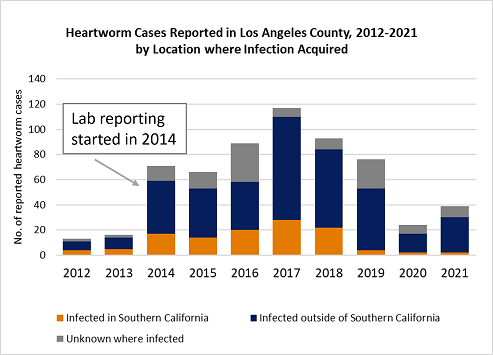
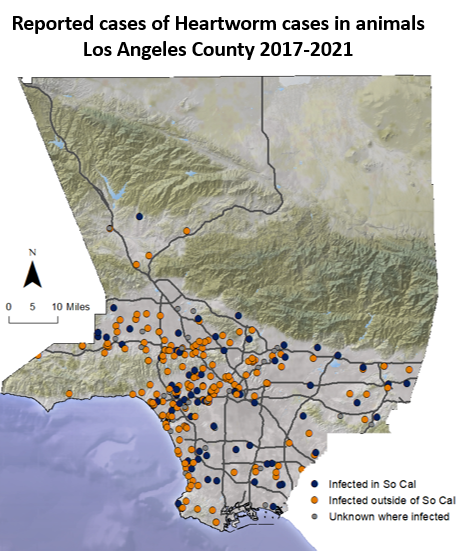
Between 2012-2021, veterinarians in Los Angeles
County reported 604 cases - in 24 cats and 580 dogs. The
majority of the cases (80%) had no symptoms
at the time they were
diagnosed.
In 19.5% of these cases, the pet had not traveled
outside of Southern California, so they had
acquired the infection locally. The graph seen
at the right
shows these cases by year.
The amount
of reports received per year increased in 2014
because laboratories began to report cases.
How Can I Prevent Heartworm
in My Pet?
1. Mosquito Control.
Mosquitoes breed in stagnant water. Stop
mosquito breeding by dumping any standing water
on your property every 2 days. Mosquitoes feed
the most at dawn, dusk and at night, so keep
your pet indoors at night.
2. Heartworm Preventative Medication.
Heartworm preventative medications are generally
regarded as safe and help prevent infection with
additional parasites. Discuss the issue with your pet’s
veterinarian.
Untreated animals
Untreated animals may become "reservoirs" for the
disease. This means they can infect mosquitoes,
and then the mosquitoes can infect more pets.
Infected coyotes can be reservoirs for the
disease.
Can humans catch heartworm?
Human infections with Dirofilaria
immitis are very rare. Clinical findings in
humans with heartworm infection have included
having a small shadow ("coin
lesion") in the lungs as seen on a chest
X-ray, or finding a heartworm in a lump under
the person's skin. No cases of human heartworm
infection have been reported in LA County.
Tracking Heartworm in LA County
Heartworm in animals is reportable in
LA County. In 2014, laboratories
were required to begin reporting cases, and the
reports available increased. Cases are
categorized as Confirmed, Probable, or Suspected
based on the
Heartworm Case Definition for LA County.
Reporting Heartworm Cases
VETERINARIANS: Report a case of heartworm disease by using
this form
 and
email it in to
vet@ph.lacounty.gov or fax to 213-481-2375. and
email it in to
vet@ph.lacounty.gov or fax to 213-481-2375.
|